Lead Response Time: Why 47 Hours Kills UK Trade Business Profits
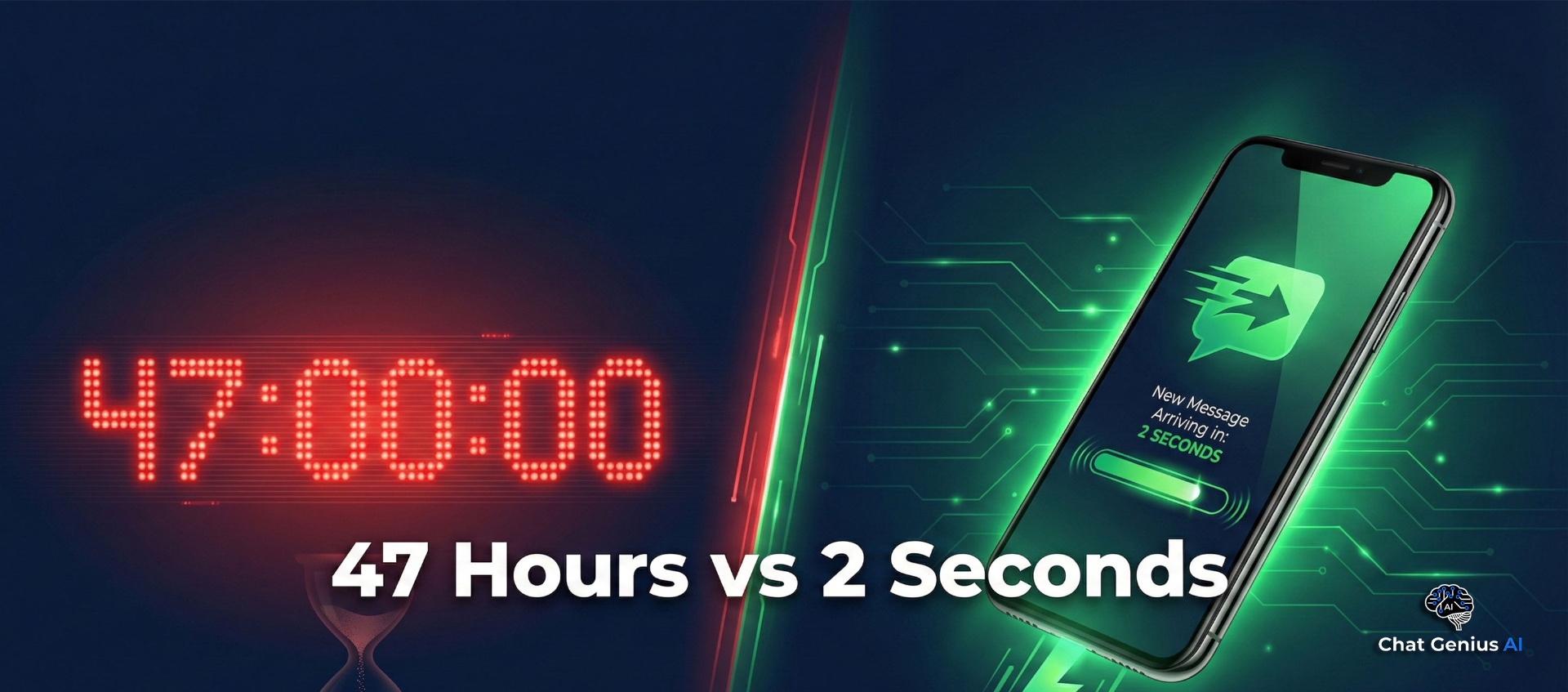
FIG 01: Lead Response
The Speed Problem No One Talks About
Walk into any trade business networking event and you will hear the same complaints:
"Leads are getting more expensive"
"Competition is fierce"
"Customers are more price-sensitive"
But rarely do you hear: "I am too slow to respond to leads."
That is because most business owners do not track their response times. They do not realise that while they are debating marketing strategies and adjusting their pricing they are haemorrhaging money through delayed responses.
The UK Trade Industry Benchmark
Recent industry research shows that UK service businesses average 47 hours from initial enquiry to first response. Let that sink in for a moment.
Forty seven hours means:
Enquiry comes in Monday morning
You respond Wednesday afternoon
Customer has already booked someone else Tuesday evening
The Psychology of Lead Response
Understanding why response time matters requires understanding customer psychology especially in emergency situations.
The Emergency Mindset
When someone needs a plumber electrician or roofer they are often in crisis mode:
Water is pouring through their ceiling
They have got no heating in winter
Their electrical system has failed
In these moments customers are not comparison shopping. They are not looking for the cheapest quote. They want someone who can help them right now.
The Cooling-Off Effect
Even for non-emergency work motivation decreases rapidly over time:
Hour 1: "I need to get this bathroom sorted"
Hour 12: "I should probably get some quotes"
Hour 24: "Maybe I will wait until next month"
Hour 47: "Was I planning to do something?"
The longer you wait the less likely they are to proceed at all.
The Real Cost of Delay
Let us break down what slow response times actually cost your business:
Direct Revenue Loss
Conservative estimate:
One lost lead per week due to slow response x £500 average job value = £26,000 annual loss
Realistic estimate:
Three lost leads per week due to slow response x £650 average job value = £101,400 annual loss
Indirect Revenue Impact
But direct job loss is just the beginning. Each lost customer also means:
Lost Reviews: That customer would have left a review generating 2 to 3 additional customers over 12 months
Lost Referrals: Happy customers refer 1.5 new customers on average
Lost Repeat Business: Especially for maintenance and follow-up work
The Compound Effect
When you factor in all the indirect losses that one delayed response can cost £2,000+ in total business value.
Why Trade Businesses Are So Slow
You might be reading this thinking "I am not slow to respond." But consider these common scenarios:
Scenario 1: The Active Job
You are installing a new boiler. Takes 6 hours. Your phone rings 4 times during the installation. You cannot answer because:
You are under a floor
You are handling dangerous equipment
You are mid-conversation with the current customer
By the time you finish and check your messages 6+ hours have passed.
Scenario 2: The Evening Enquiry
It is 7pm. You have just finished a 10-hour day. You see missed calls and contact form submissions. You think "I will deal with these first thing tomorrow."
First thing tomorrow is 14+ hours later.
Scenario 3: The Weekend Emergency
Saturday night 11pm. Emergency burst pipe enquiry comes through your website. You are asleep. You see it Sunday morning at 8am.
9+ hours later. They have already called three emergency plumbers and booked the first one who answered.
The 5-Minute Rule vs The 2-Second Reality
Marketing experts often talk about the "5-minute rule". Respond to leads within 5 minutes for maximum conversion rates.
But here is the reality: if your customer has an emergency 5 minutes might still be too long. They will call the next number on their list after 2 minutes.
What 2-Second Response Looks Like
Imagine this timeline:
11:03pm: Customer submits website enquiry about emergency electrical fault
11:03pm (2 seconds later): Automated text response: "Hi this is Chat Genius AI working with Your Business. I saw your message about the electrical emergency. Are you available to chat so I can get you sorted tonight?"
11:04pm: Customer responds with details
11:06pm: AI gathers key information confirms urgency checks your availability
11:07pm: AI books emergency call-out for 7am next morning
11:08pm: Customer receives confirmation and your direct number
Result: £800 emergency call-out booked while you slept.
The Technology That Changes Everything
Modern AI agent technology can handle the entire initial response sequence:
Immediate Acknowledgment: Every enquiry gets a response within seconds regardless of time or your availability
Intelligent Questioning: AI asks the right questions to qualify the lead and understand their needs
Appointment Booking: Direct integration with your calendar for instant booking
Follow-Up Management: Automated confirmations reminders and follow-ups
Human Handover: Seamless transfer to you when required with full context
The ROI of Instant Response
Let us look at the numbers:
Current Situation:
200 leads per month
47-hour average response time
10% conversion rate
20 jobs per month
Average job value: £650
Monthly revenue: £13,000
With 2-Second Response:
Same 200 leads per month
2-second average response time
25% conversion rate (conservative)
50 jobs per month
Same average job value: £650
Monthly revenue: £32,500
The Numbers:
Additional monthly revenue: £19,500
Annual increase: £234,000
Investment required: £4,000 setup + £127 monthly
ROI: Over 15,000% annually
Competitive Advantage
While your competitors are still playing phone tag with prospects you are booking jobs instantly. This creates a massive competitive advantage:
Customer satisfaction: Instant response creates a professional impression
Market share: You capture leads that competitors lose to slow response
Premium positioning: Fast service allows premium pricing
Word-of-mouth: Impressed customers refer more business
Implementation Strategy
Transitioning from 47-hour to 2-second response times requires the right technology and setup:
Phase 1: Assessment. Analyse current response times identify peak enquiry periods calculate current conversion rates
Phase 2: AI Integration. Implement AI agent technology connect to existing systems train AI on your specific services
Phase 3: Optimisation. Monitor performance refine responses expand capabilities
The Bottom Line
Every hour you delay implementing faster response systems costs you money. While you are considering your options your competitors might be implementing theirs.
The trade industry is changing. Customers expect instant responses especially for emergencies. Businesses that cannot deliver will lose market share to those that can.
The choice is simple: adapt and profit or stay slow and lose.
Book a free success session and discover exactly how much faster responses could be worth to your business.
Do not let slow response times cost you another £72,000 this year.
Watch the Full Breakdown

Ready to Transform Your Business?
Book a free Success Session and let us show you how we can implement these strategies for you.